




March 30, 2025

11 min
Published: March 20, 2025
|
Updated: May 6, 2026
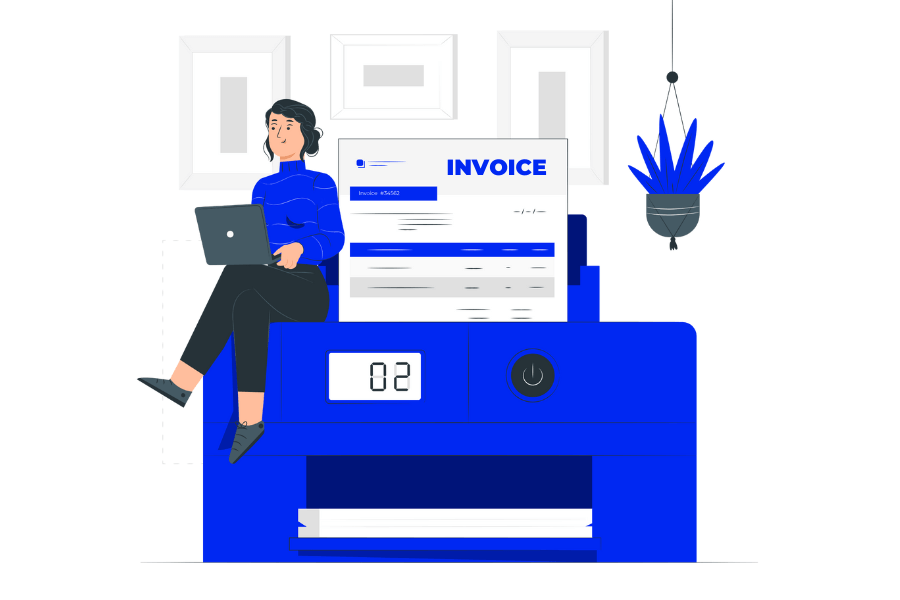
A professional invoice looks like a one-page document containing nine required fields: invoice number, business and customer details, issue and due dates, itemised goods or services, subtotal, applicable taxes, total amount due, and payment terms — laid out clearly with the total prominently displayed.
In the United States, the IRS requires “adequate records” but no specific format. In the United Kingdom and the European Union, VAT invoices must follow specific field rules. In Australia, GST-registered businesses must label the document “Tax invoice” and show their ABN. The fields are universal — labels and tax handling vary by country.
Element | Where it goes | Why it matters |
Invoice number | Top-right, labelled “Invoice No.” | Required by HMRC and EU; recommended by IRS and ATO |
Both parties’ details | Top of the page (you on left, customer on right) | Identifies who is owed and who owes |
Issue + due dates | Header area, near the invoice number | Starts the payment clock |
Itemised line items | Middle of the page, in a table | Shows exactly what is being billed |
Subtotal, tax, total | Bottom-right, total most prominent | Tax must be itemised separately for VAT/GST invoices |
Payment terms | Footer area | Sets the legal expectation for payment |
A professional invoice is a structured one-page document that requests payment for goods or services delivered, identifies both parties, itemises what is being billed, and states the total amount due along with the payment terms.
It differs from a basic invoice in three ways: a consistent layout an accounts-payable team can scan in seconds, the legal information required in the seller’s jurisdiction, and no ambiguity about what is owed, when, and how to pay it. Use a free invoice template if you want the structure pre-built — the country-specific differences are explained below.
A professional invoice accelerates payment, protects the seller during tax audits, defends the business in disputes, and signals operational maturity to clients.
Accounts-payable teams in mid-size and large companies process hundreds of invoices a week. Anything that slows them down — missing PO number, ambiguous total, vague description — moves the invoice to a manual review queue. Combine clean formatting with clear invoice payment terms and automatic payment reminders and the time from issue to paid drops noticeably.
Tax authorities in the US, UK, EU and Australia all expect invoices to evidence claimed income. Missing or duplicate invoice numbers are flagged in audits. If a customer disputes the amount, the invoice is the primary evidence — a complete, itemised invoice with all the essential invoice elements is a legally binding document; an ad-hoc one is not. The same standard applies whether you issue freelance invoices, retainers, or any of the types of invoices your business uses.
A professional invoice contains nine required fields: a unique invoice number, your business details, the customer’s details, the issue date and due date, an itemised list of goods or services, the subtotal, applicable taxes, the total amount due, and the payment terms.
Country-specific labels and a few additional requirements (VAT registration, ABN) layer on top.
Every professional invoice carries a unique invoice number — typically a sequential alphanumeric identifier such as INV-2026-0001 — placed in the top-right of the invoice header.
UK and EU rules require sequential numbering with no gaps. The IRS and ATO require uniqueness but not strict sequence. See invoice number format and examples for the full conventions.
The seller’s business name, registered address, contact details, and tax or company registration number appear at the top of the invoice.
The customer’s legal business name, billing address, and (for B2B invoices) tax registration number appear directly below the seller’s details, labelled “Bill To”.
The issue date marks when the invoice was created and the due date marks when payment is required — both appear in the header block.
UK VAT rules require an invoice within 30 days of supply; the ATO requires Australian tax invoices within 28 days of customer request. Invoice tracking with these dates makes reconciliation straightforward.
A logo and consistent visual identity appear in the header to confirm the seller’s identity at a glance and reinforce brand trust.
Each good or service is listed on a separate line with a clear description, quantity, unit price, and line total — typically in a table in the middle of the invoice.
Vague descriptions are the most common reason B2B accounts-payable teams reject invoices. “Strategy workshop, 4 hours, 12 March 2026” is specific. “Consulting services” is not.
The subtotal, applicable taxes, and grand total appear stacked at the bottom-right, with the total displayed in the largest, most prominent typography.
Tax must be itemised separately on VAT and GST invoices. If you accept payments online, placing a payment-link button beside the total reduces friction further.
The payment terms — including the payment window, accepted payment methods, and any late-payment penalties — appear in a fine-print section below the totals.
“Payment due within 30 days. Late payments incur 1.5% monthly interest. Pay by bank transfer or card.” See our guide on selecting the right payment methods for which options serve which client types.
A short thank-you note or signature appears at the bottom of the invoice as the closing professional touch.
Optional but high-value. The cover email matters too — see how to write an effective invoice email for the framing that gets invoices opened and processed.
Invoice rules are set by each country’s tax authority: the IRS in the US requires adequate records, HMRC in the UK mandates specific VAT-invoice fields, the ATO in Australia requires GST-invoice formatting, and the EU VAT Directive sets minimum fields for every member state.
US federal law does not prescribe an invoice format, but the IRS requires businesses to maintain adequate records that substantiate all reported income.
Per IRS Publication 583, every invoice must have a unique identifier, an issue date, both parties’ details, itemised charges, and a total. Sequential numbering is recommended, not required. Records must be kept at least 3 years. Sales tax is set at state and local level — there is no federal sales tax. Electronic invoices are fully accepted.
HMRC requires UK VAT-registered businesses to issue invoices with a unique sequential invoice number, both parties’ VAT details, the supply date, an itemised description, and VAT broken out separately at each rate.
Under VAT Notice 700/21, a UK VAT invoice must show a unique sequential number with no gaps, the seller’s VAT number, the customer’s name and address, the issue and supply dates, line-item descriptions and unit prices, the VAT rate per line, the VAT total in Sterling, and the gross total. Simplified VAT invoices are allowed for retail sales of £250 or less. Invoices must be issued within 30 days of supply and kept for at least 6 years.
The Australian Taxation Office requires every tax invoice to be labelled “Tax invoice”, show the seller’s ABN, identify both parties, and itemise the GST charged on each supply.
Per GSTR 2013/1, GST-registered businesses must issue tax invoices within 28 days of customer request for any taxable sale of AUD 82.50 or more (including GST). For sales of AUD 1,000+, the buyer’s identity or ABN must also appear. Tax invoices must be retained for at least 5 years. Australian businesses are increasingly adopting Peppol e-invoicing for B2B and B2G.
The EU VAT Directive requires every invoice issued in a member state to contain a sequential number that uniquely identifies the invoice, both parties’ VAT details, the supply date, the taxable amount, and the VAT rate and amount per rate.
Article 226 of Council Directive 2006/112/EC sets the minimum invoice fields. Member states may add their own requirements — Germany’s GoBD rules require tamper-proof numbering, for example. Most member states require invoices retained 6–10 years. The EU is rolling out mandatory electronic invoicing or B2B supplies under the ViDA initiative through 2030.
Download the Billdu Invoicing app on your Android or iOS phone to easily manage your finances and streamline your invoicing process!


A professional invoice is designed for scannability: a clear visual hierarchy with the total prominent, branded but uncluttered, sized for both screen and A4/Letter print.
The buyer’s AP team needs to find five things in three seconds: who the invoice is from, what it is for, the total, the due date, and how to pay. Four design principles deliver this:
If you start from a free invoice template, these principles are built in. The full process from blank to send-ready is in our guide on how to make an invoice, and the cover email is covered in how to send an invoice.
B2B accounts-payable teams reject invoices for five recurring reasons: missing or wrong invoice number, wrong tax treatment, vague itemisation, mismatched purchase-order reference, and wrong “Bill To” entity.
The six most common professional-invoice mistakes are burying the total, inconsistent numbering, missing payment terms, mid-invoice marketing copy, no “Invoice” label, and ambiguous currency notation.
Create professional-looking invoices quickly and effortlessly with Billdu. Click here to start streamlining your billing process with invoicing software for small businesses!





Sign up now for a 30-day free trial and get 20% off on your first subscription
By signing up you agree to Terms of use and Privacy policy