

Belgium · E-Invoicing Compliance
Peppol-Compliant
E-Invoicing for Belgium
Available to download on ·


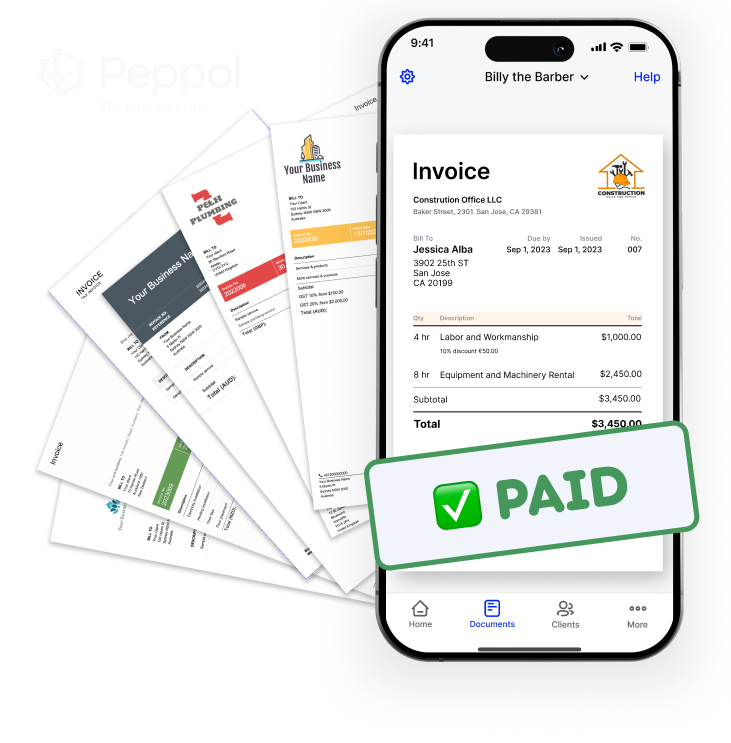



Since 1 January 2026, every VAT-registered business established in Belgium must issue structured electronic invoices for domestic B2B transactions. The required standard is Peppol BIS Billing 3.0 (UBL 2.1), based on the European EN 16931 norm.
Billdu makes this simple. Create an invoice the way you always have - Billdu converts it to Peppol BIS 3.0 and delivers it through our certified Peppol Access Point, in seconds.
The grace period ended on 1 April 2026, and penalties of €1,500-€5,000 per offence now apply. With Billdu, compliance is automatic. You don't need a separate Access Point provider, technical setup, or developer help.


When you send an invoice, Billdu converts it into the Peppol BIS Billing 3.0 (UBL 2.1) format required by Belgian law and transmits it through the Peppol network to your customer's Access Point. Registration on the Peppol network completes within seconds using your CBE number.
Everything is handled inside the app - no setup work on your side, no manual XML, no extra subscription.
Your invoices go through our certified Peppol Access Point
Compliant with EN 16931 - the European e-invoicing standard
Works for both B2B and B2G (via Mercurius)
Full status tracking - Sent, Accepted, Refused, Viewed, plus Error visibility on failures
Auto-locked invoices after submission - no silent edits, audit-ready
Billdu isn't a Peppol-only tool bolted to your business. It's a full invoicing app that handles the Belgian sending mandate for you.
Send invoices via Peppol when the law requires it. Send the same invoice as a PDF, email, SMS, or shared link when you're billing customers outside Peppol - like consumers, or non-Belgian clients. One workflow, one app, one subscription.
When a Peppol invoice needs correction, Billdu issues a compliant e-credit note linked to the original. No standalone credit notes, no compliance grey areas.

Not sure if Billdu is the right Peppol solution for your business? Here's what you get out of the box.

Compliant Peppol BIS 3.0 sending in seconds. Receiving handled via our certified Access Point.

Penalties start at €1,500 per offence. Billdu keeps every invoice compliant.

SMEs and self-employed can deduct 120% of eligible e-invoicing costs through tax year 2027.
Everything required by the Belgian mandate, plus the workflow tools to keep your invoicing fast.

UBL 2.1 syntax, EN 16931–compliant. Billdu converts your invoice automatically.

Integrated on our side - no separate Access Point subscription needed.

Every invoice tracked through Sent, Accepted, Refused, Viewed - plus Error visibility on any failed delivery.

Issue corrections the right way - linked to the original, sent via Peppol.

Invoice Belgian government entities through the same flow. No extra setup.

Billdu checks your business profile before activation so invoices don't fail.
The B2B mandate is already live. Since 1 January 2026, every VAT-registered business established in Belgium must issue structured electronic invoices in the Peppol BIS Billing 3.0 format for domestic B2B transactions. A tolerance period applied between January and March 2026; full enforcement began on 1 April 2026.
The B2G mandate (invoicing public entities) has been in force regionally since 2017, and at the federal level since 2022–2024, via the Mercurius platform.
Must comply: all VAT-registered businesses established in Belgium that issue invoices to other Belgian VAT-registered businesses, regardless of company size.
Exempt:
Peppol (Pan-European Public Procurement On-Line) is a standardized international network for exchanging structured electronic business documents. It uses a four-corner model: Sender → Access Point → Peppol Network → Access Point → Receiver. In Belgium, the Peppol authority is BOSA (Federal Public Service Policy and Support).
Your company's address on the network is a Peppol ID, based on your CBE number with the prefix 0208 (for example: 0208:0999888777). You can't connect to Peppol directly — you must use a certified Access Point. Billdu connects you automatically.
Yes. When you create an invoice in Billdu, it's converted to the required Peppol BIS Billing 3.0 format and delivered via the Peppol network to your customer. Activation completes in seconds, and every invoice is tracked through clear statuses: Draft → Sending → Sent → Accepted/Refused/Viewed.
Receiving Peppol e-invoices directly inside Billdu isn't currently available - to receive, use B2B Router as your receiving Access Point, or choose any other certified Belgian provider.
Peppol e-invoicing for Belgium is available on the Standard and Premium plans. If you're on Lite, you'll be prompted to upgrade automatically when you activate e-invoicing.
Activation is restricted to super owner and manager roles within your Billdu account.
Penalties apply per offence:
A minimum interval of 3 months applies between penalties for the same unresolved issue. An improperly formatted invoice can also cause your customer to lose their VAT deduction - a strong reason for the business community to enforce compliance among each other.
Yes. Belgian SMEs and self-employed persons can claim a 120% tax deduction on eligible e-invoicing investments - including software subscriptions, Access Point fees, and implementation costs - for tax years 2024 through 2027. Billdu Standard and Premium plans, used for Peppol invoicing, fall within the categories the deduction applies to. Confirm eligibility with your accountant based on your specific situation.
You can still send invoices via PDF or email as before - Billdu supports both flows. However, since 1 January 2026, both parties in a Belgian B2B transaction are legally required to use structured e-invoicing.
If your customer isn't registered on Peppol, they are non-compliant and risk fines themselves. The practical advice: inform your customer about the obligation and encourage them to register with a Peppol Access Point as soon as possible.


Activate in minutes and stay compliant from invoice one.

Sign up now for a 30-day free trial and get 20% off on your first subscription
By signing up you agree to Terms of use and Privacy policy