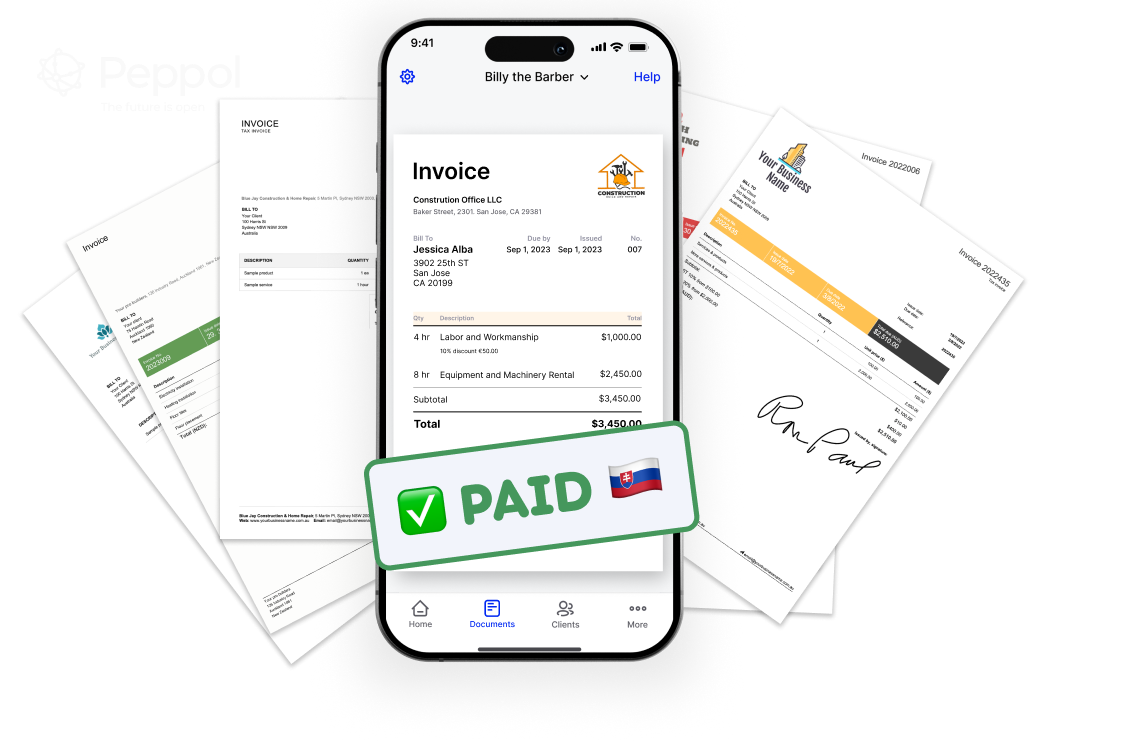
Slovakia · E-Invoicing Compliance
Prepare for Mandatory eFaktúra in 2027

We're building support for e-invoicing (eFaktúra) over the Peppol network and will launch it well before 1 January 2027, so you're ready in time. Use Billdu for all your invoicing today — and we'll let you know the moment it goes live.
An e-invoice - in Slovakia called eFaktúra - is an invoice in a structured XML format that businesses exchange over the European Peppol network through a certified service provider, known locally as a digitálny poštár (“digital postman”). In Slovakia it becomes mandatory on 1 January 2027 for all VAT payers on domestic B2B and B2G invoices. Every business - including sole traders and non-VAT-registered businesses - must be able to receive them.
What eFaktúra is | A structured electronic invoice (XML) under the EN 16931 standard, delivered over the Peppol network |
Who it applies to | Issuing: all VAT payers · Receiving: every business, including non-VAT-registered businesses, sole traders and the self-employed |
In effect from | Mandatory from 1 Jan 2027 · a voluntary phase is already running in 2026 |
Format | XML - Peppol BIS Billing 3.0 / UBL 2.1, EN 16931 standard |
How it’s delivered | Through a certified service provider (digitálny poštár), acting as a Peppol Access Point |
Penalties | Up to €10,000 per breach, up to €100,000 for repeated breaches |
Legislation | Act No. 385/2025 Coll. (amendment to the VAT Act) · EU ViDA directive 2025/516 |
Slovakia is introducing mandatory e-invoicing through Act No. 385/2025 Coll., which amends the VAT Act and transposes the EU’s ViDA (VAT in the Digital Age) directive. From 1 January 2027, every VAT payer established in Slovakia must issue invoices electronically for domestic B2B and B2G transactions. Paper invoices and PDFs will no longer be enough — they are replaced by the structured Peppol BIS Billing 3.0 (XML) format under the EN 16931 standard.
A voluntary phase is already running in 2026, so you can prepare without pressure. Failing to comply from 2027 carries penalties of up to €10,000, and up to €100,000 for repeated breaches.
Where does Billdu fit in? We’re building support for mandatory e-invoicing into Billdu. The goal is simple: you create an invoice the way you always have, and Billdu handles the conversion to the Peppol format and its delivery through a certified service provider. We’ll launch this support well before 1 January 2027. Until then, use Billdu for all your everyday invoicing — switching e-invoicing on later will be a single step.

The obligation has two sides - and this is what catches many businesses out. Issuing e-invoices is one thing; being able to receive them is another.
Who must issue e-invoices
- All VAT payers established in Slovakia, on domestic invoices to another business (B2B) or to the state and public institutions (B2G).
- The obligation follows VAT registration, not how you claim expenses.
When you do NOT need an e-invoice
- Invoicing final consumers (B2C) - unchanged (paper, PDF, cash-register receipt).
- Simplified invoices and eKasa receipts stay valid within the statutory limits.
- VAT-exempt supplies and specific cases.
Who must be able to receive - nearly everyone
- Every taxable person invoiced by a VAT payer - including sole traders, the self-employed and non-VAT-registered businesses.
- Also liberal professions (lawyers, notaries, architects, artists), self-employed farmers and landlords carrying out an economic activity.
- A non-VAT-registered business doesn’t issue e-invoices, but must be able to receive them through a certified service provider.
A digitálny poštár - literally a “digital postman” - is a certified delivery service provider that acts as a Peppol Access Point. Think of it as the mail carrier for digital invoices: it validates the format, encrypts the content and securely delivers the e-invoice, while passing selected data to the Financial Administration (Finančná správa). From 2027, without a contracted certified service provider you can’t send or receive e-invoices.
An important distinction: invoicing software and a certified service provider are not the same thing. Invoicing software (like Billdu) creates the invoice; the certified service provider delivers it. Most businesses need both - unless their invoicing app handles Peppol delivery for them.
That’s exactly what we’re building in Billdu: invoice creation and Peppol delivery in one place. We’ll launch e-invoicing support before it becomes mandatory.
Billdu is a full invoicing app you can use today - and we’re building support for mandatory e-invoicing into it. Start now, and the switch will be smooth.
Create an invoice in seconds - desktop, tablet or mobile, in front of your customer
Send it as a PDF, by e-mail or via a link and get paid online
Credit notes, quotes, expenses and stock - your whole workflow in one place
Full invoice status tracking - sent, delivered, seen
Peppol BIS Billing 3.0 (XML/UBL 2.1) under EN 16931 - no manual XML
Sending e-invoices over Peppol straight from Billdu, via a certified service provider
Receiving e-invoices from suppliers into your account
Reporting data to the Financial Administration in line with the law
Once we launch e-invoicing support, the whole process will be simple:
Enter the invoice in Billdu the way you always have — desktop or mobile.
Billdu converts it into the Peppol BIS 3.0 (XML) format under EN 16931.
Sent over Peppol to the recipient; selected data goes to the Financial Administration.